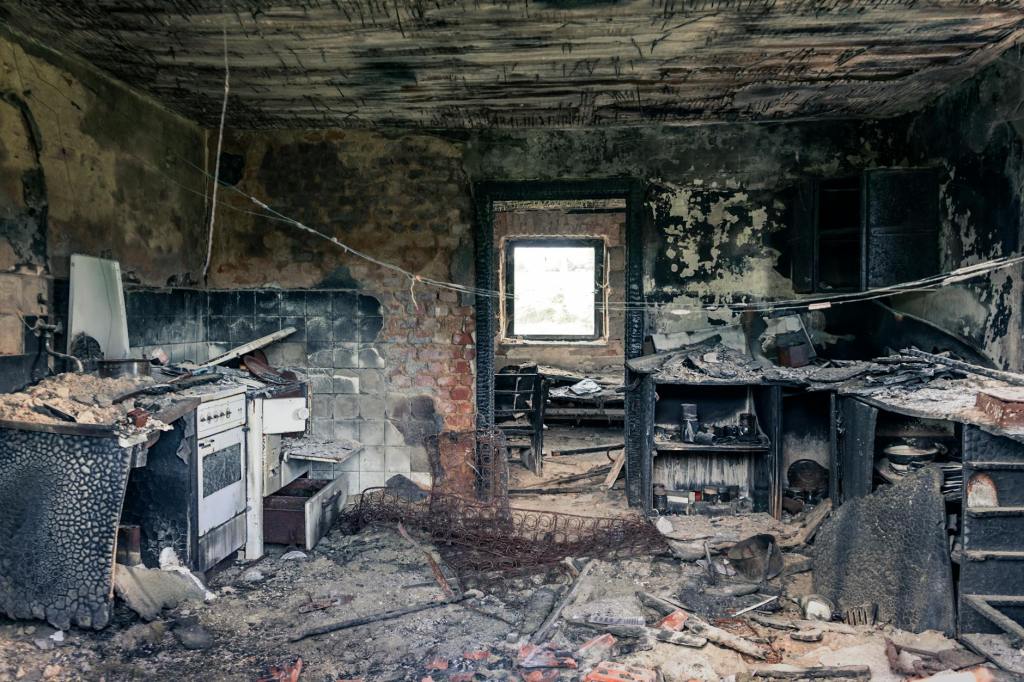
A man stood in the center of what once had been his home. Now, it was nothing more than charred remains—splintered bones of walls jutting upward like a skeleton trying to remember what it once held together. Blackened studs still outlined rooms where laughter once lived. The scent of smoke lingered, but the fire was long gone. Only the aftermath remained.
His beard was matted with soot. His dark hair clung to his forehead with sweat, though the flames had died weeks ago. The heat now came from within—a burning shame, an aching grief. It was his fault. He took a slow step forward, boots crunching on glass and broken memories.
There, half-buried in the ash, was a picture frame—twisted, cracked. He bent down and pulled it from the rubble. A family portrait. The corners of the photograph were burned away, but he could still see their faces. His wife’s soft smile, the brightness in the eyes of his children. And himself, arms wrapped around them. A man he barely recognized. They were not dead but they were gone. The destruction hadn’t taken lives but it had taken life.
His knees gave out. He sank to the ground, clutching the scorched frame to his chest as a cry tore from his throat. A cry deeper than sound. His tears fell onto the ashes, streaking through the soot on his cheeks.
Then—knock knock knock.
He looked up.
There, standing where the front door used to be, was a man. Not just any man. He wore no suit of brilliance, no glowing halo, and yet His presence was unmistakable. Eyes like flame and oceans both. Hands scarred. Peace in His very posture.
Jesus.
He stood at the edge of the wreckage, at the threshold of what was once the front door—though now only a charred doorpost remained to mark the spot. He knocked on it, gently, deliberately.
“Can I come in?” He asked, voice low and tender.
The man lifted his eyes. He looked around at the bare studs, the open air, the complete exposure. There was nothing stopping Jesus from walking in.
Yet still, He asked.
Though the tears, the man let out a soft snorted laugh. He found a fleeting moment of humor in the irony of the question. Then tears welled up again as he realized the question offered dignity when none was warranted. A simple nod was all he could muster in response.
Jesus stepped in.
Each step was reverent, like He was walking into a sacred temple, not the shell of a broken life. He knelt beside the man without a word and wrapped His arms around him. The embrace was not weak or distant—it was the embrace of someone who had come not just to comfort, but to heal.
The man tried to speak, to explain what he had done, to justify, to confess, to apologize—but his lips trembled, and the words would not come.
Jesus held him closer.
Then, gently, He took the ruined photo from the man’s hands. He looked at it with eyes full of knowing and compassion.
“I’ve got them,” He said.
The man looked up, heart breaking anew at those words. He searched Jesus’ face, but there was no anger there. Only mercy.
Then Jesus extended His hand.
“Come on,” He said. “Let’s rebuild it.”
The man stared at that hand, calloused and pierced. A builder’s hand. A Savior’s hand.
He took it.
They turned from the ashes together and began to walk—past the broken beams and walls, past the wreckage of regret and ruin. The man looked back once, at what was lost.
Then Jesus squeezed his hand, and the man looked forward again.
And together, they walked into the morning.
 EPHword
Leave a comment