There is a striking pattern woven through Scripture—one that is easy to miss at first glance, yet profound once seen. Across different generations, different battles, and different purposes, we find the same posture repeated: a man with arms outstretched between two others.
This is not coincidence. It is a prophetic pattern. A physical posture that becomes a spiritual declaration. A visible sign of God’s victory over His enemies.
Three stories. One pose.
Moses on the Mountain: Victory Through Intercession
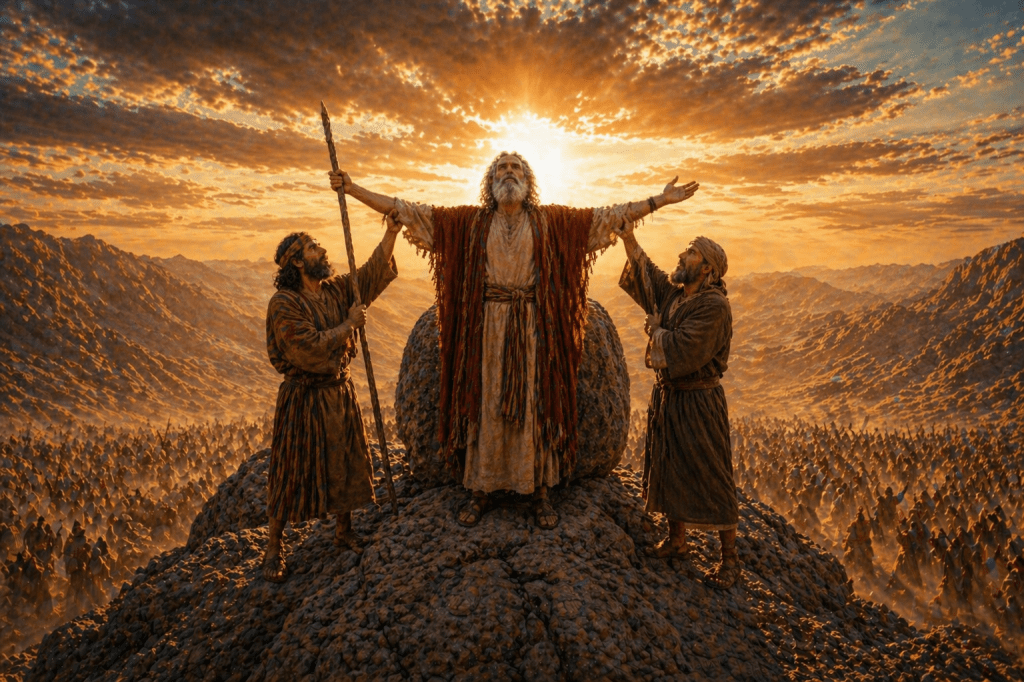
Exodus 17:8–13
The first scene unfolds during Israel’s battle with Amalek. As Joshua leads the army in the valley, Moses ascends the hill with the staff of God in his hand.
“Whenever Moses held up his hand, Israel prevailed; and whenever he lowered his hand, Amalek prevailed.” (Exodus 17:11)
Moses stands with his arms lifted—outstretched toward heaven. This is not merely a gesture; it is an act of intercession. The battle below is directly tied to the posture above.
As long as his arms remain extended, Israel prevails. When they fall, the enemy gains ground.
As the day pressed on, Moses grew weary. His arms grew heavy and started to fall to his sides. Aaron and Hur climbed the mountain to support Moses. They placed a rock for him to lean on. They then held his arms, one on each side, until the sun sets and victory is secured.
“His hands were steady until the going down of the sun.” (Exodus 17:12)
Imagine what the soldiers saw from the valley below. Three figures atop a mountain with arms outstretched. This image represented victory for the people of God, and defeat for the enemies of God. Quite a picture.
Here we see a powerful truth: God’s victory is mediated through a physical posture of surrender. The battle is not won by strength alone, but by submission to the power in heaven.
Samson Between the Pillars: Victory Through Sacrifice
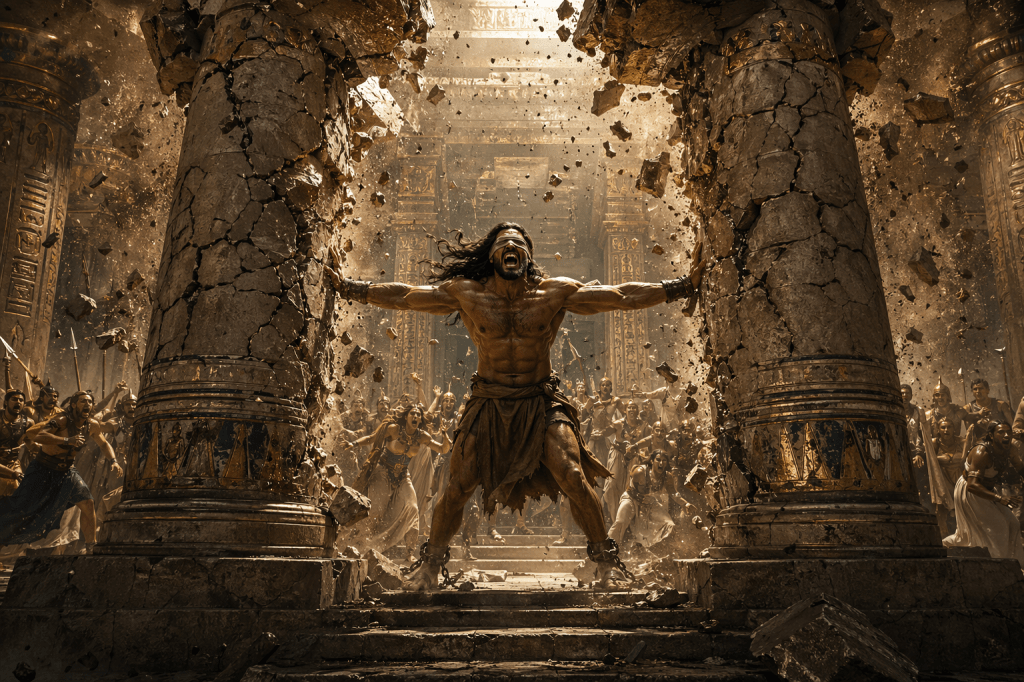
Judges 16:23–30
The second scene shifts to the temple of Dagon, where Samson—the once-mighty judge of Israel—stands blind, humiliated, and bound.
He was placed betweenu two pillars to be mocked and cursed by the Philistines. He stretched out his arms, placing one hand on each column and prayed:
“O Lord God, please remember me and please strengthen me only this once…” (Judges 16:28)
With the strength of God returned to him, he extended his arms to the farthest he could. The pillars collapsed. The temple fell. Samson went to the grave taking the persecutors of God’s people with him.
This posture—arms extended, pressing outward—becomes a picture of victory through sacrifice. Samson’s final act is not merely strength, but surrender. His body becomes the very instrument of judgment against God’s adversaries.
Jesus on the Cross: Victory over sin and death
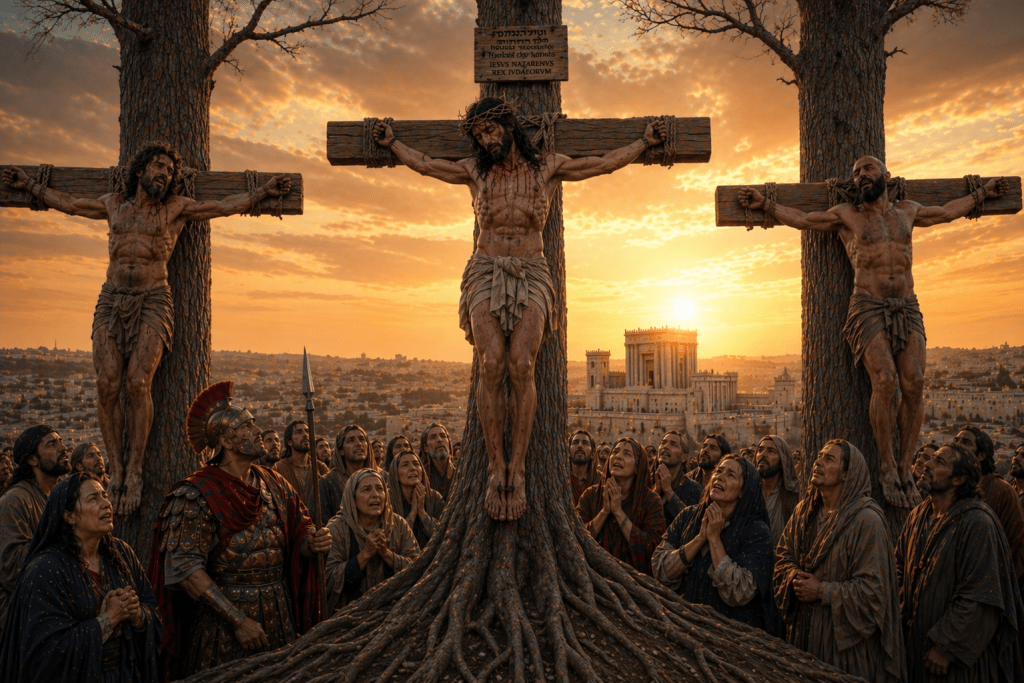
Luke 23:26–43
The final and ultimate expression of this pattern is found at the cross. Jesus was lifted up, His arms stretched wide, cursed to hang on a tree.
He was crucified between two thieves; they were mounted to their own pillars. Why were they there? One reason: to connect back to the story of Moses, Aaron, and Hur. What was the image of Israel’s victory again? Three figures atop a mountain with arms outstretched…
One of those thieves mocked the Messiah. His judgment became that of the Philistines.
The other with his dying breath prayed the prayer of Samson: “Lord, remember me…“
Just as Moses’ lifted hands brought victory, and Samson’s outstretched arms brought destruction to God’s enemies, Jesus’ stretched arms bring the ultimate victory—over sin, death, and the powers of darkness. Christ took every curse and persecution with Him to the grave.
At the cross, the pattern of victory reaches its zenith:
- Not just intercession and surrender (like Moses).
- Not just strength and sacrifice (like Samson).
- But the culmination of both stories to bring salvation to all mankind
Three stories. One Pose
When the people of God stretch out their arms, it is not just a posture, it is a proclamation:
Victory belongs to the LORD, and I surrender to Him!


Leave a Reply