I recently was invited to a new men’s Bible study. I have a usual weekly engagement at the same time so I am unable to attend regularly, but one week, my schedule was open for me to attend. There were about 30 men who gathered at a small business. They were very welcoming and we enjoyed some food before it got started. While gathering at a large ring of chairs, there was some worship, we then discussed Revelation 6, and then did communion and prayer. Honestly, It was the most passionate and reverent partaking of communion I have ever witnessed. It truly was a sweet time of fellowship. There was one major issue I had with the group.They had a very heavy emphasis on the Pre-Tribulation Rapture.
The Pre-Trib Rapture was mentioned regularly during the study. Their flyer for the Bible study said “Meeting every Tuesday until the Rapture.” Several times while talking about Revelation, it was mentioned how the Church won’t be present for the events being discussed. It was talked about so often that I wanted to chime in and ask them what was even the purpose of studying Revelation at all. What no one there knew about me is that I don’t believe in the Pre-Trib Rapture. When we got done with the Bible study, I talked to the leader and informed him of my position. He got very eager and excited to debate the subject. Unfortunately there wasn’t a lot of time to talk as many needed to leave and close up. But before I left, he made sure to hand me a sheet of paper with some Bible verses for me to study about the Pre-Trib Rapture. The references he gave were:
- Revelation 3:10
- Luke 21:36
- 1 Thessalonians 1:10, 5:9
- Daniel 12:1
- 2 Thessalonians 2:5:8.
I will address each of these passages later in this article, but before I do, I want to make sure we all understand what the Rapture is. The Rapture is a theological concept in Christian eschatology (end-times study) referring to the event when living believers in Jesus Christ (the Church) will be gathered, taken up, or caught up from the earth to meet Christ in the air. The word rapture comes from the Latin word “rapturo,” which is a translation of the Greek word “harpazō” found in 1 Thessalonians 4:17, meaning “to seize,” “catch up,” or “snatch away.” It should be noted that the Rapture is not the same thing as the Return of Christ, the Day of the LORD, or the Resurrection. These are separate events described in the Bible that seem to happen concurrently with the Rapture. There are three specific passages that specifically mention the event of the Rapture. They are:
Matthew 24:31 – “And He will send His angels with a great sound of a trumpet, and they will gather together His elect from the four winds, from one end of heaven to the other.“ (This verse also appears in Mark 13:27)
1 Thessalonians 4:16-17 – “For the Lord Himself will descend from heaven with a shout, with the voice of an archangel, and with the trumpet of God. And the dead in Christ will rise first. Then we who are alive and remain shall be caught up together with them in the clouds to meet the Lord in the air. And thus we shall always be with the Lord.”
2 Thessalonians 2:1 – “Now, brethren, concerning the coming of our Lord Jesus Christ and our gathering together to Him,…
While the doctrine of the Rapture is widely accepted among Christians, its details and timing are debated among different theological and denominational traditions. Some denominations do not emphasize it at all, while others see it as central to their eschatology (such as this Bible study I visited). Notice something very interesting; These three verses that specifically describe the Rapture were not given to me to study about the pre-trib rapture. Why is this? Why wouldn’t any study of the Rapture (regardless of timing) begin with the verses that literally describe the event? I will dive into all of these passages in detail to see if they might clue us into the timing of the Rapture. We will approach the subject from a purely exegetical standpoint. That means with no preconceived ideas as to when it is. I will start from scratch and let Scripture interpret Scripture.
Section 1 – Bible Passages About the Rapture
Rapture Passage 1 – The Olivet Discourse
Matthew 24:3 – Now as He sat on the Mount of Olives, the disciples came to Him privately, saying, “Tell us, when will these things be? And what will be the sign of Your coming, and of the end of the age?”…
There are many passages of Scripture that describe what will happen at the end of time. I consider the most significant to be when the Messiah himself was asked about it by His disciples and chimed in on the subject. This description of end-times events spoken of by Jesus is often referred to as the Olivet Discourse. There are parallel passages to this story in Mark 13 and Luke 21 but for the most part we will focus on Matthew 24. All three accounts should be read in their entirety but I will summarize to save time and ink.
Jesus answers his disciples saying they will hear of wars and rumors of wars, famines, pestilence, and earthquakes but that is merely the beginning of sorrows (verses 4-8). He then warns them they will be hated for His name’s sake, lawlessness will abound, love will grow cold, but encourages them saying “he who endures to the end shall be saved” (verses 9-14). He then describes a period of time called the Great Tribulation beginning with an event called the Abomination of Desolation spoken of by the prophet Daniel. It will be a time of distress that has never been seen before nor ever will again. There will be false prophets and false christs attempting to deceive many. But He says that God will cut those terrible days short for the sake of His elect (chosen ones) that will be there during the Great Tribulation (verses 15-28). Now here comes the kicker:
Matthew 24:29-31 – “Immediately after the tribulation of those days the sun will be darkened, and the moon will not give its light; the stars will fall from heaven, and the powers of the heavens will be shaken. Then the sign of the Son of Man will appear in heaven, and then all the tribes of the earth will mourn, and they will see the Son of Man coming on the clouds of heaven with power and great glory. And He will send His angels with a great sound of a trumpet, and they will gather together His elect from the four winds, from one end of heaven to the other.
There it is – The Rapture – our deliverance from the Great Tribulation! But Jesus specifically said it comes after the Tribulation. The timing of things is apparent in this passage. Jesus used sequencers such as after and then thus giving us a clear order of events. If you were going to make a simple timeline based on the last three verses I quoted, it would look like this:
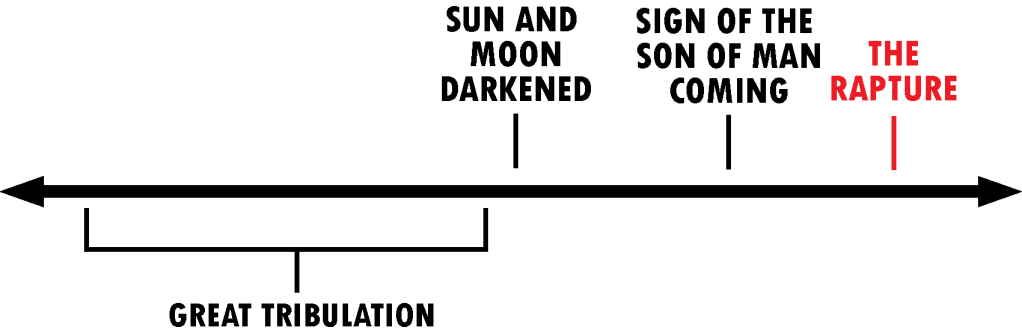
When Jesus was asked what the end would be like, He described events before the Tribulation (wars, famines, pestilence, earthquakes), events during the Tribulation (a time of distress, false prophets, false christs) and events after the Tribulation (the sun darkened, the Son of Man appearing, the gathering of the elect). You can read The Olivet Discourse in three different gospels in 900 translations; nowhere did Jesus ever describe a gathering of believers before the Tribulation. If there is to be a significant event such as believers in Christ being removed from the earth prior to the tribulation, why did Jesus not mention it? Either Jesus failed to mention the most important event of the end times involving believers OR such an event is not going to take place at all.
Rapture Passage 2 – The Resurrection of the Dead in Christ
1 Thessalonians 4:15-17 – For this we say to you by the word of the Lord, that we who are alive and remain until the coming of the Lord will by no means precede those who are asleep. For the Lord Himself will descend from heaven with a shout, with the voice of an archangel, and with the trumpet of God. And the dead in Christ will rise first. Then we who are alive and remain shall be caught up together with them in the clouds to meet the Lord in the air. And thus we shall always be with the Lord.
This passage contains the most explicit description of the rapture in the Bible specifically mentioning meeting the Lord in the air among the clouds. These verses also mention an even more miraculous event happening at the same time: the resurrection of the dead. Other passages in the Bible mention this same event.
1 Corinthians 15:51-52 – Behold, I tell you a mystery: We shall not all sleep, but we shall all be changed— in a moment, in the twinkling of an eye, at the last trumpet. For the trumpet will sound, and the dead will be raised incorruptible, and we shall be changed.
Revelation 20:4-6 – …Then I saw the souls of those who had been beheaded for their witness to Jesus and for the word of God, … And they lived and reigned with Christ for a thousand years. But the rest of the dead did not live again until the thousand years were finished. This is the first resurrection. Blessed and holy is he who has part in the first resurrection.
There is a lot going on here but to summarize: with a shout from heaven and the sounding of a trumpet, the dead in Christ will be resurrected. According to Revelation the ones who will be resurrected are the ones who were killed for their faith in Jesus. This will be an amazing thing to witness. But look again at the verses in 1 Thessalonians 4. Paul writes that “we who are alive and remain until the coming of the Lord will by no means precede those who are asleep” and also “the dead in Christ will rise first.” So the Rapture happens after the resurrection of the dead. I know a lot of Christian brethren who are waiting for the Rapture to happen, but shouldn’t they be looking for the resurrection of a whole bunch of believers to happen first? That’s what the Bible says will happen first. In my mind, the resurrection is an even greater miracle to get excited about than the Rapture. Here is a simple timeline based on 1 Thessalonians 4:15-17.

Rapture Passage 3 – The Apostasy and the Man of Sin Revealed
2 Thessalonians 2:1-3 – Now, brethren, concerning the coming of our Lord Jesus Christ and our gathering together to Him, we ask you, not to be soon shaken in mind or troubled, either by spirit or by word or by letter, as if from us, as though the day of Christ had come. Let no one deceive you by any means; for that Day will not come unless the falling away comes first, and the man of sin is revealed, the son of perdition,
Here we have even another passage describing the Rapture but also describing other events that must happen first. The first event mentioned is called “the falling away.” Other translations call this event “the great rebellion” or “the apostasy.” It is believed that at some point in time, many believers will give up their faith in Christ. Perhaps the events of the tribulation will be too much for them to bear. We also have the revealing of “the man of sin” who is better known as the Antichrist. Once again, the Apostle Paul explicitly states these two events come first, and then our gathering together with Jesus will happen. If were to make one simple timeline combining all the information from all three passages that describe the Rapture, it would look like this:
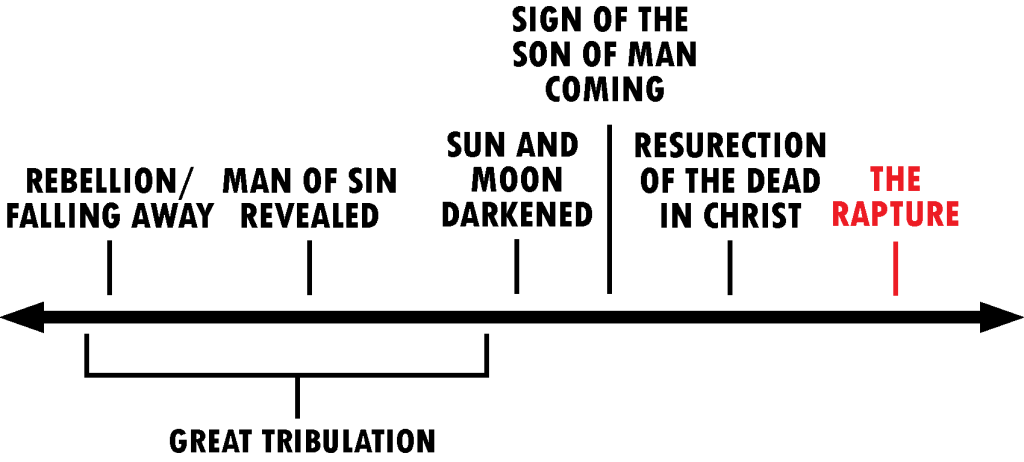
This timeline has no scale or units of measurement. It is simply to illustrate the order of events described in the passages I have referenced. We have three passages that specifically describe the Rapture and in all three, there are events that are explicitly described as happening before the Rapture. There is not any interpretation needed when both Jesus and Paul use sequencers in their verbiage. It is because of these passages that I hold to a post-tribulation rapture belief.
Section 2 – Scripture Considered for the Pre-Trib Rapture
To be fair and balanced in this article, I will address all of the Bible verses that were given to me that support the pre-tribulation rapture theory in addition to other arguments often made to support those claims. I will also add my commentary to each reference.
1. “Kept from the Hour of Trial”
Revelation 3:10 – Because you have kept My command to persevere, I also will keep you from the hour of trial which shall come upon the whole world, to test those who dwell on the earth.
Initially reading this verse, it does speak of God sparing a group of believers from a worldwide judgment thus supporting a pre-tribulation rapture viewpoint. A closer examination of the text shows it does not require removing believers from the earth. The phrase “keep you from” (In the Greek: tēreō ek) can also mean to guard, protect, or preserve through something. The exact same phrase appears in John 17 during Jesus’ prayer:
John 17:15 — I do not pray that You should take them out of the world, but that You should keep them from the evil one.
In this one sentence, Jesus is contrasting the two ideas; to be kept from the evil one is different from being taken out of the world. Here, believers are protected while staying in the world, not removed from it. The “keeping” is meant to be spiritual protection in the midst of danger, not physical removal. Not to mention, the prayer of Jesus here for us to not be taken out of the world seems to refute the entire basis of the pre-trib rapture as a whole.
The book of Revelation often emphasizes patience and faithfulness through trials (see Revelation 2:10 and Revelation 13:10). The Church of Philadelphia is praised for perseverance, suggesting they would be shielded spiritually or protected in some way during the coming hour of trial, but not necessarily raptured away beforehand. Thus, Revelation 3:10 can reasonably be interpreted as a promise of preservation during tribulation, not escape from tribulation.
2. “Worthy to Escape”
Luke 21:34–36 – But take heed to yourselves, lest your hearts be weighed down with carousing, drunkenness, and cares of this life, and that day come on you unexpectedly. For it will come as a snare on all those who dwell on the face of the whole earth. Watch therefore, and pray always that you may be counted worthy to escape all these things that will come to pass, and to stand before the Son of Man.”
This is taken from Luke’s version of The Olivet Discourse. Here we have the key phrase from verse 36, “escape all these things” that is considered to support the pre-trib rapture. However, the rest of the passage has Jesus imploring His followers to “watch” and “pray always” pointing us toward faithfulness and perseverance during trials that will come to pass, not avoiding them altogether. The word “escape” here (Greek: ekpheugō) means to flee out of or survive through. The idea of escaping an event implies that the event has happened but you are able to evade its consequences, not to be physically removed from it before it has even happened.
You also must take the rest of the chapter in context. Earlier in the discourse Jesus said this:
Luke 21:25-28 – “And there will be signs in the sun, in the moon, and in the stars; and on the earth distress of nations, with perplexity, the sea and the waves roaring; men’s hearts failing them from fear and the expectation of those things which are coming on the earth, for the powers of the heavens will be shaken. Then they will see the Son of Man coming in a cloud with power and great glory. Now when these things begin to happen, look up and lift up your heads, because your redemption draws near.”
Jesus is telling His disciples that when the Son of Man comes in the clouds, they are to look up and lift their heads. That implies they will be on the earth to see the signs in the heavens, not already in the air with Christ.
3. “Not Appointed to Wrath”
1 Thessalonians 5:9–10 – For God did not appoint us to wrath, but to obtain salvation through our Lord Jesus Christ, Who died for us, that whether we wake or sleep, we should live together with Him.
Verse 9 here is one of the most common verses I have heard used to support the idea that believers of Christ will be spared from facing the events of the Great Tribulation. Once again context is important to the argument. The first ten verses of chapter 5 are talking about the Day of the Lord. This is the single day of judgment that happens at the end of the Great Tribulation. The use of the word wrath here is in regards to eternal wrath as the result of God’s judgment.
Even still, we can set aside that context to be fair to the argument. Yes, the term wrath is associated with the Great Tribulation as it says in Revelation:
Revelation 6:17 – For the great day of His wrath has come, and who is able to stand?”
If believers in Christ are not appointed to wrath, it could be implied they are removed before it begins. But the verse asks a question, who is able to stand? Jesus answered that question back in the Olivet Discourse in a verse we already covered.
Luke 21:36 – Watch therefore, and pray always that you may be counted worthy to escape all these things that will come to pass, and to stand before the Son of Man.
Taking all these verses together, we who are believers are able to stand in the day of God’s wrath since we are justified by the blood of Christ. Paul said this in Romans 5.
Romans 5:9–10 – Much more then, having now been justified by His blood, we shall be saved from wrath through Him. For if when we were enemies we were reconciled to God through the death of His Son, much more, having been reconciled, we shall be saved by His life.
We are promised to be saved from God’s wrath. We can be spared from His judgment because our eternal salvation is assured. Once again this can be done without being transported off of the earth during the time of tribulation.
4. “Your People Shall Be Delivered”
1 Thessalonians 1:10 – and to wait for His Son from heaven, whom He raised from the dead, even Jesus who delivers us from the wrath to come.
Daniel 12:1 “At that time Michael shall stand up, The great prince who stands watch over the sons of your people; And there shall be a time of trouble, Such as never was since there was a nation, Even to that time. And at that time your people shall be delivered, Everyone who is found written in the book.
The passages here are talking about what it is to be delivered by God. Upon reading these verses, it does sound like Jesus will remove us from the wrath to come and that God’s people are exempt from this “time of trouble” spoken of by Daniel. But what does deliverance actually look like in practice? Does deliverance mean the same thing as being removed or exempted from something?
If I mailed a package to a friend in a blizzard, I am expecting that parcel to still be delivered to my friend on time. Is my parcel exempt or removed from the blizzard or does my shipment still have to endure the blizzard? Yes, it is kept safe, but a good mail service doesn’t wait for the storm to pass; it delivers the package through the storm. This is how deliverance works. We as believers say we are delivered from our sins, however, we are not completely removed from sin. We still have to face sin and overcome the temptation to sin, even though we say we have been delivered from sin. In the end-times, we will be delivered in the same way, not from tribulation, but through tribulation.
5. The Church is the Restrainer
2 Thessalonians 2:5:8 – Do you not remember that when I was still with you I told you these things? And now you know what is restraining, that he may be revealed in his own time. For the mystery of lawlessness is already at work; only He who now restrains will do so until He is taken out of the way. And then the lawless one will be revealed, whom the Lord will consume with the breath of His mouth and destroy with the brightness of His coming.
The argument made in these verses is that the Scripture describes one who is restraining or holding back the man of sin and that at some point this restrainer will be taken out of the way for this antichrist to then be revealed. Supporters of the pre-tribulation rapture interpret the “restrainer” to be the Holy Spirit working through the Church. If the Church is removed/raptured from the earth, then the Antichrist can then be revealed and fulfill this prophecy.
This is purely theoretical. If the Holy Spirit is what is standing in the way of the antichrist rising to power, it does not require the physical presence of the church on earth to do its job. The restrainer could literally be a person on earth who is standing in the way of the antichrist’s rise to power at which point these verses would have no bearing on the rapture of the church.
I already talked about the first three verses in this chapter proving that the man of sin/lawlessness is revealed before the rapture. Since the timing of the rapture is already covered in the first three verses, the argument about verses 5-8 is a moot point.
6. “I go to prepare a place for you”
John 14:2–3 – In My Father’s house are many mansions; if it were not so, I would have told you. I go to prepare a place for you. And if I go and prepare a place for you, I will come again and receive you to Myself; that where I am, there you may be also.
Jesus told His disciples that He is preparing a place in heaven for them and that He will come again and receive them to Himself. This is a very common verse often associated with the rapture. I don’t necessarily disagree with that idea, but there is absolutely no time frame mentioned. Because it describes the second coming of Christ and then receiving His followers to Himself, it better supports the idea of the rapture happening when Christ returns after the tribulation and not before.
7. The Church is Absent from the Tribulation in Revelation
The church is mentioned frequently in Revelation 1-3, but afterwards references to the church disappear from the Tribulation descriptions.
Revelation 4:1 – After these things I looked, and behold, a door standing open in heaven. And the first voice which I heard was like a trumpet speaking with me, saying, “Come up here, and I will show you things which must take place after this.”
Supporters of the pre-trib rapture interpret the phrase “come up here” to be a reference to the church being raptured before any of the events of the tribulation are described in the rest of the book. Many things in the book of Revelation appear to be metaphorical. In John’s vision he heard a voice drawing him into heaven. That does not directly imply there is a future event when the church is drawn up into heaven. The lack of mention of the church in descriptions of tribulation events is entirely circumstantial. You cannot just conclude the church is absent because it is not specifically referenced.
If anything, Revelation specifically states that believers come out of the great tribulation.
Revelation 7:9,13–14 — After these things I looked, and behold, a great multitude which no one could number, of all nations, tribes, peoples, and tongues, standing before the throne and before the Lamb, clothed with white robes, with palm branches in their hands,… Then one of the elders answered, saying to me, ‘Who are these arrayed in white robes, and where did they come from?’ And I said to him, ‘Sir, you know.’ So he said to me, ‘These are the ones who come out of the great tribulation, and washed their robes and made them white in the blood of the Lamb.
There is a multitude of people that no one can number who have robes made white by the blood of the Lamb (meaning their sins have been forgiven). Those people are ones who come out of the great tribulation according to the verse above. Pre-trib supporters may argue that this group of people are people who come to faith during the tribulation. I agree there will be many who will find faith in the Messiah during the tribulation. But here is the biggest question: Where in the book of Revelation is any mention of a group of people who never face tribulation? If the church of faithful believers are truly raptured before the tribulation, where is any specific reference to that rapture? Where in the Bible is the description of their return to earth with the Messiah? These passages do not exist.. We cannot trust what is not in the Bible. We can only live by what is actually written in the word of God.
8. The “Elect” in the Olivet Discourse are Unbelieving Jews.
According to the Olivet Discourse, it is clear that a group of people called the “Elect” are present during the Tribulation and that they are raptured after the Tribulation. Believers of the Pre-Trib Rapture claim the elect (In the Greek: eklektos meaning ‘chosen’) are the unbelieving Jews who were not raptured with the church. There is one major problem with that. The Bible uses the same Greek word to describe believers in Jesus.
Romans 8:31–35,38–39 – What then shall we say to these things? If God is for us, who can be against us? He who did not spare His own Son, but delivered Him up for us all, how shall He not with Him also freely give us all things? Who shall bring a charge against God’s elect? It is God who justifies. Who is he who condemns? It is Christ who died, and furthermore is also risen, who is even at the right hand of God, who also makes intercession for us. Who shall separate us from the love of Christ? Shall tribulation, or distress, or persecution, or famine, or nakedness, or peril, or sword?… For I am persuaded that neither death nor life, nor angels nor principalities nor powers, nor things present nor things to come, nor height nor depth, nor any other created thing, shall be able to separate us from the love of God which is in Christ Jesus our Lord.
Colossians 3:12–13 – Therefore, as the elect of God, holy and beloved, put on tender mercies, kindness, humility, meekness, longsuffering; bearing with one another, and forgiving one another, if anyone has a complaint against another; even as Christ forgave you, so you also must do.
Titus 1:1 – Paul, a bondservant of God and an apostle of Jesus Christ, according to the faith of God’s elect and the acknowledgment of the truth which accords with godliness,…
All of these passages use the same Greek word eklektos to describe believers in Christ. You have to do verbal gymnastics to claim in the Olivet Discourse that the “elect” are unraptured, unbelieving jews going through tribulation while Paul uses the exact same word for the first-century church. The “elect” is the church—Those who have a testimony of faith in Jesus Christ.
Jesus said plainly in the middle of the Olivet Discourse “You will be hated by all for My name’s sake. But he who endures to the end shall be saved.” (Mark 13:13). Who is Jesus talking to? He is not talking to unbelievers who are out of luck and missed the rapture at the start of the tribulation. He is talking to His followers who are hated for His name’s sake. The jews are not hated for the name of Jesus, Christians are. So who are the ones that will endure to the end of the Tribulation? Answer: the Elect, Christians, the Church! The good news is, the Bible says even tribulation cannot separate us from the love of Christ. Good thing too because we are going to need it. The elect are those who will be delivered through Tribulation, NOT from Tribulation. Blessed is the one who waits for and reaches the end of the 1,335 days. – Daniel 12:12(NIV) The blessing is for those who endure to the end. The Bible never mentions a different blessing for a different group of people that will never face the Great Tribulation.
Section 3 – Final Thoughts
In section one, I cited the Bible passages that specifically mention the Rapture. Every one of them describe events that must occur before the rapture happens. The sequence of events are clear and easy to understand. In section two, I cited the Bible passages that are used to support the pre-tribulation rapture. Each of those passages require conjecture and interpretation to even relate them to the rapture. In this final section, I will share my final thoughts about the timing of the rapture and the deliverance of God’s people through the Great Tribulation.
The Pattern of Israel
The way that Israel was saved from Egypt sets the precedent by which God saves His people. When the children of Israel were still slaves, they were kept safe from the judgment and plagues of Egypt. The children of Israel were not removed from Egypt before the plagues came upon the land. They were delivered through the judgment of God by the blood of the lamb on their doorposts. This was God’s divine protection. They were protected in the midst of judgment. We should expect the same treatment when the whole world is judged in the last days.
When the Israelites left Egypt, it specifically says they did not travel to the promised land by way of the Philistines although it was near. Instead God led them through the wilderness (Exodus 13:17–18). They did not take a shortcut to get to the promised land. God needed to test them in the wilderness to change them from a kingdom of slaves into a kingdom of people who could live with law and order and in obedience to God. This is the same purpose of the Tribulation in the last days. Just like Israel, we must endure a “wilderness experience” before our hearts will be ready to be citizens in God’s kingdom.
Do Not Be Deceived
When speaking about the coming of the Son of Man, both Jesus and Paul issue strong warnings for believers to stay alert and not be deceived about the events surrounding Christ’s return.
Matthew 24:4 – Take heed that no one deceives you.
2 Thessalonians 2:3 – Let no one deceive you by any means;
These warnings highlight that deception about the end times would be a major danger for the Church, not something to be casually overlooked. Despite these clear warnings, many Christians today have been lulled into complacency by the popular teaching of the pre-tribulation rapture without ever being exposed to alternative interpretations. They simply trust the tradition handed to them without personally studying what Scripture actually says. They have not done their due diligence and unknowingly ignored the very first instruction Christ and Paul gave about the end: “Do not be deceived.”
A major concern with the widespread teaching of a pre-tribulation rapture is that it mirrors the pattern of deception described by the prophet Jeremiah. Speaking of false prophets in his day, Jeremiah wrote:
Jeremiah 23:16–17 – Thus says the Lord of hosts: ‘Do not listen to the words of the prophets who prophesy to you. They make you worthless; they speak a vision of their own heart, not from the mouth of the Lord. They continually say to those who despise Me, “The Lord has said, ‘You shall have peace’”; And to everyone who walks according to the dictates of his own heart, they say, “No evil shall come upon you.“
Just as Jeremiah warned against leaders who falsely promised peace and safety, today many teachers proclaim that the Church will be spared from tribulation entirely. They assure believers, “You will not face tribulation! You will be gone before any hardship comes!” Yet Scripture repeatedly emphasizes endurance through trials, not escape from them. In this critical hour, believers must obey the urgent call of Scripture to study diligently, discern carefully, and refuse to be deceived — no matter how popular or comforting a teaching might seem.
The Most Likely reason for the Great Apostasy / Falling Away
The Bible warns that before the return of Christ, there will be a widespread rebellion against the true faith—commonly called the Great Apostasy or the Great Falling Away. This was already mentioned when I covered 2 Thessalonians 2:1-3. This event appears to coincide with the rise of the antichrist. Paul teaches that before Christ’s return, many who once professed faith will abandon sound doctrine. This falling away is not a small or hidden event; it will be a massive spiritual collapse where false teaching, moral compromise, and deception will sweep through the visible Church.
2 Timothy 4:3–4 – For the time will come when they will not endure sound doctrine, but according to their own desires, because they have itching ears, they will heap up for themselves teachers; and they will turn their ears away from the truth, and be turned aside to fables.
What if that deception and false teaching has already been planted in the church? When Christians are taught that they will be removed before any great suffering comes, it sets them up for disillusionment and potential falling away when tribulation actually does arrive! What will happen if a majority of Christians who believed they would never have to face the Great Tribulation start to see undeniable apocalyptic events unfold in the world? When faced with the reality of enduring the Tribulation when they were expecting to be raptured before, how many will give up their faith in God and the Scriptures? How many will be too afraid to persevere? The teaching of the pre-trib rapture may not be the primary reason for the falling away, but I can envision it being responsible for many brethren to be unprepared for the trials to come. May this be a sobering warning for all believers to stand firm, know what the Scripture says, love the truth, and endure faithfully to the end.
Final Exhortation
Acts 14:22 – …strengthening the souls of the disciples, exhorting them to continue in the faith, and saying, ‘We must through many tribulations enter the kingdom of God.
Paul and Barnabas encouraged the early believers to stay strong, reminding them that tribulation is part of the Christian journey. We must prove to our Heavenly Father that we will choose to believe in Him and follow His ways, even when times get tough. As believers today, we must not grow complacent thinking we will have it any better than believers in the past. Stay vigilant. We should prepare to endure any and all tribulations until the kingdom of God has arrived.
John 16:33 – These things I have spoken to you, that in Me you may have peace. In the world you will have tribulation; but be of good cheer, I have overcome the world.”
Jesus promises that we will have peace even when surrounded by tribulation. We should rejoice because our deliverance through that tribulation will be the tangible evidence of God’s power to overcome the world!
Romans 5:3–4 — And not only that, but we also glory in tribulations, knowing that tribulation produces perseverance; and perseverance, character; and character, hope.
Tribulation is the refining process that ultimately strengthens the believer. Many believers today do not yet have the perseverance and character to be a citizen of the kingdom of God. Our God is in the business of refining His people and He uses trials and tribulation to do exactly that. I know it sounds scary, and there is no promise of shortcuts or an easy way out. God does promise to protect us and deliver us through the Great Tribulation. We will endure to the end. We must have no fear but the fear of God.



Leave a comment